
Cattle Egret in North America: An Old World Colonizer's Story
A tropical heron that crossed the Atlantic on its own and conquered a continent in a few decades, the Cattle Egret is now retreating at its northern edge. Here is the whole arc.
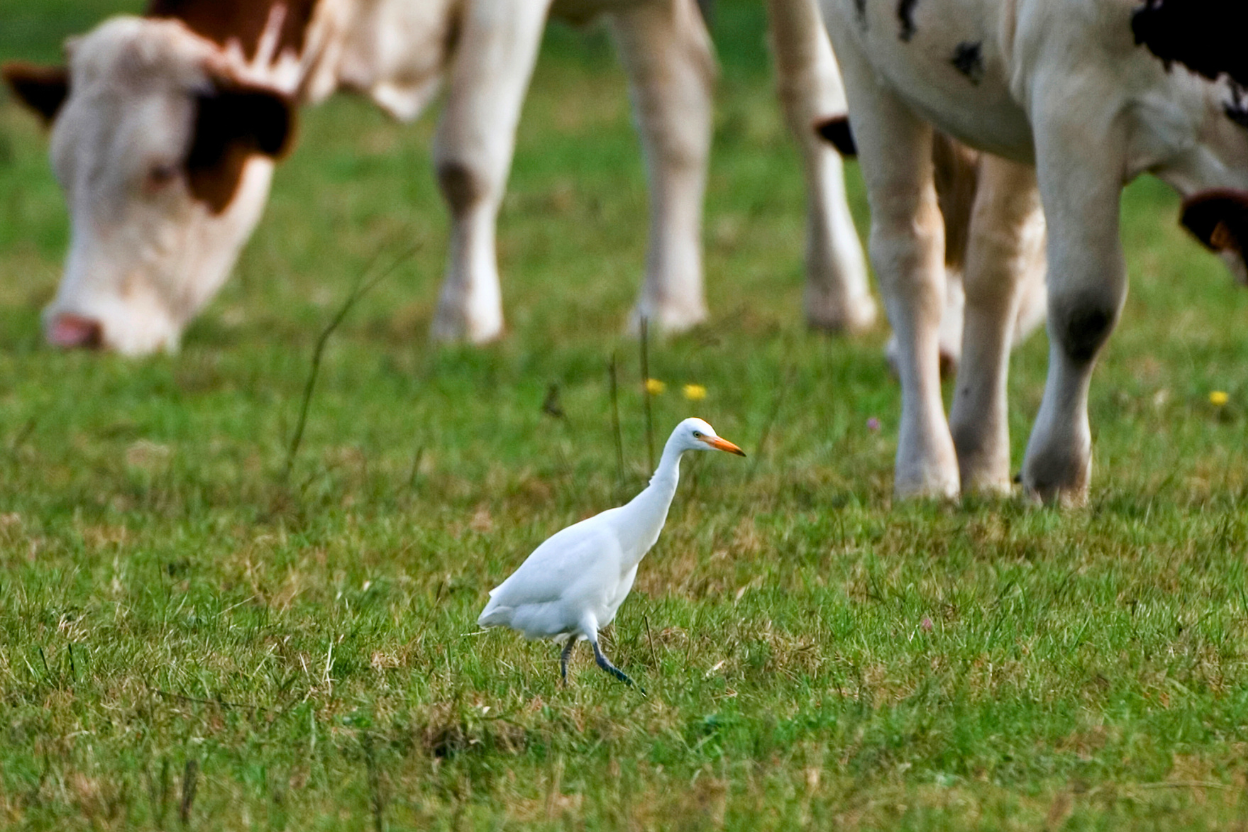
You are driving past a pasture, half watching the road, when a spot of white resolves among the dark backs of the cattle. Not a gull, not a scrap of trash, but a small white heron picking through the grass at the animals' feet, riding the wake of the herd. A Western Cattle-Egret, and the small surprise of it, a tropical bird standing in a temperate field, never quite wears off. What makes the surprise worth holding onto is that this bird had no business anywhere in the Americas until about a century and a half ago, and it got here entirely on its own.
The fastest crossing
The Cattle Egret is an Old World bird, native to Africa and warmer parts of Europe and Asia, where it has always followed grazing herds to snap up the insects they flush. Sometime around 1877 a few of them did something no one expected: they crossed the Atlantic. Naturalists on the boundary of Guiana and Suriname noted a strange new heron, almost certainly birds carried west from the African coast on the spring trade winds, a crossing that models suggest can take under a week. For decades they stayed a South American curiosity, becoming established there only in the 1930s. Then the pace changed. The first North American bird turned up in Florida in 1941, where it was dismissed as an escaped zoo bird. It bred in Florida by 1953, in Canada by 1962, and from there it went everywhere, coast to coast and north to Alaska and Newfoundland within about fifty years. By 1973, two decades after that first Florida nest, ornithologists were calling it the most plentiful egret in North America. No bird's natural range has expanded faster or farther.
How a heron conquered a continent
The speed came from the bird itself. Cattle Egrets are restless dispersers, gregarious, and unfussy about food, and they had a partner in the spread without knowing it: us. As people converted forest and marsh into pasture and cropland across the Americas, they laid out mile after mile of exactly the open, insect-rich, livestock-dotted habitat the Cattle Egret exploits best. A bird built to follow herds arrived on a continent busy manufacturing herds. That pairing of a wandering, adaptable species with new habitat is the same engine behind the whole cluster, and we take it apart in Bird Vagrancy and Range Expansion Explained. What set the Cattle Egret apart was simply how fast it ran the play. Where the Glossy Ibis took the better part of two centuries to reach Maine, the Cattle Egret crossed the continent in a few decades.
Now it has two names
If you went looking for this bird in eBird today, you would not find a plain Cattle Egret. In 2023 the taxonomic authorities that eBird follows split the old Cattle Egret into two species. The birds of the Americas, Europe, Africa, and western Asia became the Western Cattle-Egret (Ardea ibis), shifted into the genus Ardea alongside the larger herons, while the birds of southern and eastern Asia and Australasia became the Eastern Cattle-Egret. The two look much alike outside the breeding season but differ when nesting, the eastern bird washing a deeper butterscotch across its upperparts. For a North American reader the practical upshot is small: the bird in your local field is now formally the Western Cattle-Egret, though nearly everyone, us included, still just says Cattle Egret.
The high-water mark, and the retreat
A range expansion this fast was never going to climb forever, and the Cattle Egret's has turned. United States numbers peaked around 1971 and have been sliding since, down roughly forty percent on the North American Breeding Bird Survey between 1966 and 2019, about one percent a year. The retreat is sharpest at the northern edge, north of the Carolinas, where the bird was always more thinly spread. Virginia's coastal population fell by nearly all of itself over three recent decades, and in New York, near the northern limit of breeding, a species once counted in the hundreds now musters about a pair a year. So in the Northeast the Cattle Egret has become less a breeder than a passer-through, and the ones that reach Quebec and southern Canada are mostly irruptive spring overshoots and post-breeding wanderers, single birds at the ragged edge of the range. The white egret you catch in a northern pasture is, more often than not, exactly that kind of bird: a straggler, not a settler.
Same story, three speeds
That makes the Cattle Egret a useful bookend. It is one of three Old World waterbirds that crossed the Atlantic and colonized North America under their own power, and the three are strung out along the same path at different points. The Cattle Egret ran it fastest and has already crested and begun to fall. The Glossy Ibis, which arrived earlier but spread more slowly, is settled and still adjusting, its story in Glossy Ibis Range Expansion in North America. The Little Egret is only now doing what the Cattle Egret did in 1941, arriving as a rare transatlantic vagrant that a future birder may look back on as the start of something, told in Little Egret in North America. When you learn to recognize a bird that has turned up where it should not be, a skill we lay out in How to Identify a Vagrant or Range-Expanding Bird, you are really learning to read these arcs in real time, one surprising white egret at a time.
FAQ
Cattle Egrets reached the Americas on their own. Around 1877, birds apparently crossed the Atlantic from West Africa on the trade winds and appeared on the boundary of Guiana and Suriname. From that South American beachhead the species spread north, arriving in Florida in 1941, where the first birds were dismissed as escapees, and breeding there by 1953. Within a few decades it had spread across the continent.
In 2023 the taxonomic authorities that eBird follows split the old Cattle Egret into two species. The population across the Americas, Europe, Africa, and western Asia became the Western Cattle-Egret, placed in the genus Ardea, while the birds of southern and eastern Asia and Australasia became the Eastern Cattle-Egret. The North American bird is therefore now the Western Cattle-Egret, though most people still call it simply a Cattle Egret.
Not really, at least not anymore. After exploding across the continent through the middle of the twentieth century, the population peaked around 1971 and has been declining since. It remains common in the southern United States, but at the northern edge it has pulled back sharply and now appears there mostly as a spring or post-breeding wanderer rather than a breeder.
The Cattle Egret is native to the Old World, originally to Africa and warmer parts of Europe and Asia, where it evolved to follow large grazing animals and eat the insects they stir up. It expanded on several fronts in the late 1800s and 1900s, reaching the Americas around 1877 and later colonizing Australia and spreading north in Europe. Its worldwide expansion is one of the most dramatic of any bird.
Yes. According to the North American Breeding Bird Survey, Cattle Egret numbers fell by roughly forty percent between 1966 and 2019, about one percent per year. The decline is steepest north of the Carolinas. Virginia's coastal population, for instance, dropped by nearly all of its birds over three recent decades, and in New York the species has nearly stopped breeding. It remains a species of low global concern, but its North American high-water mark has passed.