
Why Crossbills Breed Whenever They Want: The Nomads That Ignore the Calendar
Crossbills turn up when they feel like it, in any month, and then vanish. Here is what decides where they go, when they breed, and how you can find out which population you just met.
Crossbills always make us happy. It is the call that arrives first, that hard clipping note passing overhead, and then the search of the treetops to see whether they will land. What never quite goes away is the surprise, because we come across them throughout the year, in months when we have no reason to expect them, and the questions arrive in the same order every time. Where have these birds come from? Are they breeding? Where will they go next?
Those questions feel unanswerable in the moment. They are not. Crossbills are doing something genuinely different from most birds, and once you understand what governs their movements and their breeding, the surprise does not go away but it acquires a shape.
The calendar most birds keep
For most temperate birds, breeding is triggered by daylength. As days lengthen in spring, the reproductive organs come out of dormancy, hormones shift, song begins, and the whole sequence runs on a schedule that is broadly predictable year to year. It works because it is anticipatory. Increasing daylight is a reliable signal that the insects and greenery a brood needs will arrive shortly, so the bird can start the weeks-long process of building, laying and incubating before the food is actually there.
It is an excellent system for a bird eating something seasonal. For a bird eating conifer seed, it is the wrong system entirely, and the reason is that conifer crops do not follow the calendar.
What crossbills use instead
A conifer cone crop is enormous or absent, and which one it is depends on the tree species, the region and the year, in patterns that have very little to do with spring. A stand of spruce may produce heavily one year and almost nothing for the next several. Meanwhile the seed itself does not spoil. A good crop sits on the branches for months, available in November as it was in August.
So crossbills use the food itself as the trigger. Where the seed is abundant they settle and breed, and where it is not they leave. In the northeast this produces two main breeding windows, one running roughly January to April and another roughly July to September.
The winter window has a cause that is worth pausing on, because it is the opposite of what you would guess. Those birds are feeding on the previous year's cones, which have spent months weathering on the branch and have opened up and become easier to pry apart. Winter breeding is not a feat of endurance for its own sake. It is a window when the food is unusually easy to extract, and it happens to fall in the cold.
One honest qualification. Crossbills have not switched off their response to daylength altogether, and photoperiod still influences things like fat deposition and the timing of movements. What is unusual is specifically the breeding decision, which answers to seed on the tree rather than light in the sky.
Nesting with snow on the branches
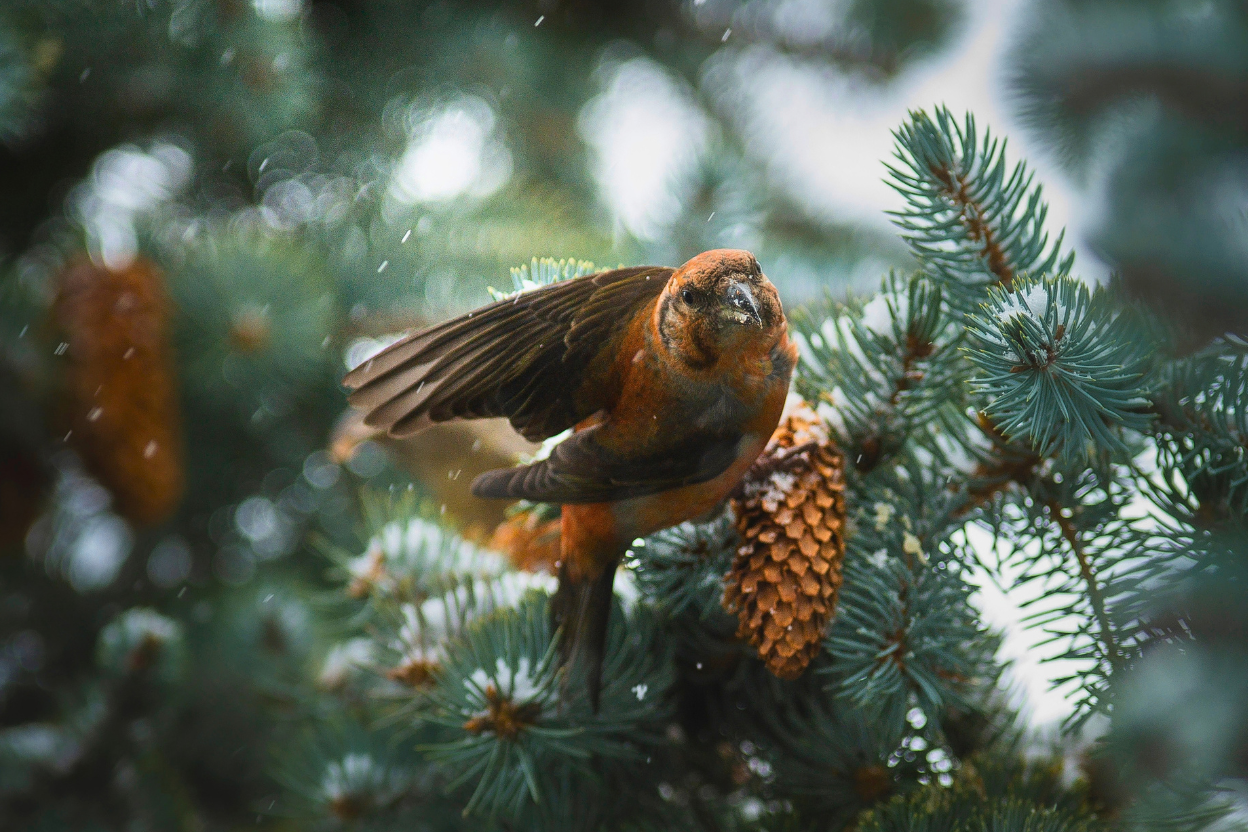
The consequence is that crossbills nest in conditions that would kill the broods of most songbirds. White-winged Crossbills (Loxia leucoptera) have been recorded singing in flight over snow-laden spruce at temperatures around minus 20 degrees Fahrenheit, and pairs will nest in deep winter wherever a cone crop justifies it.
This is viable for one reason: the food supply is not only abundant but constant. A songbird raising chicks on insects in January would fail because there are no insects. A crossbill raising chicks on spruce seed in January is working a resource that is fully stocked, does not fluctuate day to day, and does not require the parents to travel. The nest is heavily insulated and the female sits tight while the male brings food, and the arrangement works because the pantry is the tree they are sitting in.
Crossbills also feed their young largely on regurgitated conifer seed rather than insects, which removes most of the remaining dependence on the warm season. Insects are taken when seed runs short, particularly in early summer, but the nestling diet is built on seed.
The bill that makes it possible
The crossed mandible tips are among the most specialized feeding structures in any bird. The bird inserts the closed bill between the scales of a cone, opens it, and the crossed tips lever the scales apart, while the tongue lifts the seed out. It is a tool for one job, and it is exceptionally good at it.
The important part is that "one job" is more specific than it sounds. Cones differ enormously between conifer species in size, scale thickness and structure, and a bill shaped for one is not equally efficient on another. That specialization turns out to explain a great deal about which crossbills you are looking at.
So where did these birds come from?
This is the question we ask every time, and there is a real answer to it, sitting in the call.
Red Crossbill (Loxia curvirostra) is not one uniform bird. Its flight calls sort into distinct call types, with at least ten currently recognized in North America, a case argued in 2024 for an additional cryptic type in the northeast, and more than 17 described in the Western Palearctic. These are not random dialects. Each type is associated with particular conifers and carries bill proportions suited to them, so a call type is effectively a lineage specializing on a particular kind of cone.
They also appear to be on their way to becoming separate species, and in one case have already arrived. The Cassia Crossbill was split from the Red Crossbill complex as a full species in 2017, and some researchers have argued that several more North American types warrant the same treatment. This remains genuinely unsettled, and anyone telling you the number of crossbill species in North America with confidence is ahead of the evidence.
What it means practically is that the flock passing overhead has an identity beyond the species name. It belongs to a population adapted to a particular conifer, which is why it is here and which is a strong clue to where it came from. Recording the flight call with a phone is usually enough for a type to be identified later, and that recording turns an unanswerable question into a data point.
Irruptions, and why some winters they are everywhere
The other half of the movement story is failure. When cone crops fail across a wide region at once, crossbills do not wait it out. They move, sometimes in large numbers and sometimes very far, pushing south of their usual range into areas that may see them once in a decade.
This is why crossbill abundance feels so unpredictable. A winter with crossbills everywhere is generally not a good year, it is the visible consequence of a bad one somewhere north of you. And the birds arriving are not necessarily the ones that were there before, which is part of why the same location can hold crossbills in three different years and a different call type each time.
Finding them, and telling whether they are breeding
Listen before you look. Crossbills are usually detected by the flight call, often while invisible, and scanning conifers hoping to spot one is far less effective than walking with your ears open. Learn the call first and the birds will start appearing.
Go where the cones are. Check spruce, pine, hemlock and tamarack, and look up at the crowns rather than into the understory. A stand carrying an obviously heavy cone crop is worth returning to repeatedly, because that is what a crossbill is looking for too. Cone crop reports circulate among finch watchers each autumn and are the closest thing to a forecast.
Record what you hear, even badly. A phone recording is often sufficient for call type identification, and submitting it with an eBird checklist contributes to a picture of crossbill movements that is still being assembled.
Signs they are breeding out of season include persistent song in midwinter, birds carrying nesting material, a pair staying put in one stand rather than moving through, and streaky juveniles present in months when no other songbird has young. If you find any of that in January, it is worth documenting carefully, because winter breeding records remain relatively scarce.
Where they will go next
The honest answer is that it depends on next year's cones, and that nobody knows yet, including the birds. That is the part we have come to enjoy. A crossbill is not on a route. It is following a resource that moves unpredictably across a continent, and the flock overhead is somewhere in the middle of a decision that will be made by a spruce crop several hundred kilometres away.
For how the rest of the birds handle the same question of when to breed, see our guide to how birds mate, and for another species that answers it unconventionally, see lekking birds and their dance battles. If you want to read breeding behaviour in the field, including out of season, our guide to how to watch bird courtship displays covers the craft and the etiquette.