
How Do Birds Mate? The Cloacal Kiss, the Pair Bond, and What Actually Happens
The physical act takes about a second, and almost everything interesting about bird reproduction happens around it. Here is the full picture, from anatomy to the social arrangements birds actually run.
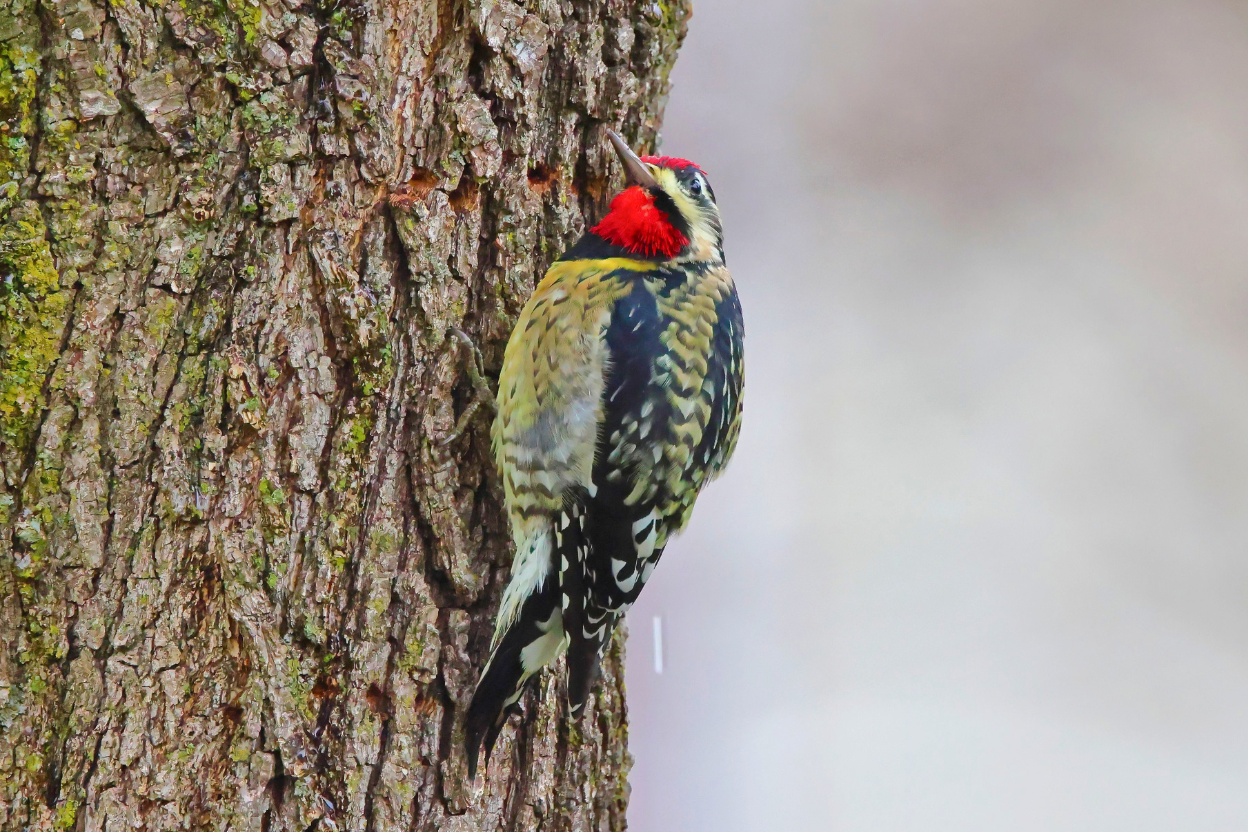
We heard her before we saw anything. A female Yellow-bellied Sapsucker (Sphyrapicus varius) calling hard somewhere in the canopy during spring migration, and around that call a great deal of movement, more chaotic than sapsuckers usually are. It read like a dispute. We spent a while working out the angle through the branches, expecting to find two birds arguing over a tree, and instead we found a pair mating. It was over almost as soon as we had them in view.
That is the honest answer to how birds mate, and it is why so many people are unsure about it. The act is brief, it happens above your head, and from below it looks a lot like a scuffle. Everything elaborate about bird reproduction happens on either side of that second or two, in the courtship that leads up to it and in the social arrangements that follow. So we will start with the mechanics, because that is what most readers came for, and then open the door onto how much stranger the rest of it gets.
The cloacal kiss: what actually happens
Birds do not have separate openings for waste and reproduction. Both sexes have a single chamber called the cloaca, which handles digestive waste, urinary waste, and gametes. Outside the breeding season it is unremarkable. As breeding approaches it swells in both sexes, and in males of many species it forms a visible bulge that researchers can use to sex birds in the hand.
Copulation itself is a matter of contact. The male steps or flutters onto the female's back, she moves her tail aside and everts her cloaca, and the two openings press together for a moment while sperm passes across. This is the cloacal kiss. It is genuinely that quick, often a second or two, and pairs frequently repeat it many times over the days around egg laying rather than relying on a single transfer.
One detail in that sequence matters more than it first appears. Without the female turning her cloaca outward, the contact does not achieve anything. She is not a passive participant in the physical act, which turns out to be a useful thing to hold onto, because female choice runs through nearly everything else in this article.
Why almost no birds have a penis, and why ducks do
Roughly 97% of the world's ten thousand or so bird species have no intromittent organ at all. That is unusual among vertebrates, and it is not an ancestral trait. Bird ancestors had one, and most bird lineages lost it.
The developmental mechanism was worked out by Ana Herrera and colleagues and published in Current Biology in 2013. Chicken embryos begin building a genital tubercle in the same way a duck embryo does. Partway through development a gene called Bmp4 switches on in the tissue, the cells begin to die back, and the structure regresses before hatching. In ducks and emus that signal stays off and the organ completes.
The exceptions are worth knowing in the field. Waterfowl keep theirs, as do ratites such as ostriches and rheas, along with tinamous and a scattering of other lineages. As for why the loss happened, the tidy explanation people reach for is weight saving for flight, and it does not survive contact with the evidence, since ducks carry substantial organs and are among the longest distance migrants there are. The better supported idea is female choice. When fertilization requires the female's cooperation, control over paternity sits with her, and there is a coherent evolutionary story in which that arrangement was selected for. The waterfowl exception, and the anatomical arms race that came with it, is a subject in its own right, and we cover it in sexual coercion in birds.
A pair bond and a copulation are two different things
Here is where the plain question opens onto a much better one. David Lack's 1968 survey put social monogamy at about 91% of bird species, and that figure is still quoted constantly, usually as evidence that birds mate for life. It does not mean that. Social monogamy describes who a bird pairs with, defends a territory with, and raises chicks with. It says nothing about who fathered those chicks.
Once DNA fingerprinting arrived in the late 1980s, the second question could finally be asked, and the answer rearranged the field. Extra-pair paternity has now been detected in over 90% of the bird species where anyone has looked for it. True genetic monogamy holds in only about 14% of surveyed passerine species. Across socially monogamous species with biparental care, an average of roughly 19% of offspring are sired by a male other than the social mate, appearing in about a third of broods, with species ranging from zero all the way to 76%.
What this looks like in familiar birds: in Black-capped Chickadees (Poecile atricapillus), females paired to lower-ranking males seek copulations with higher-ranking neighbours, and extra-pair sires are consistently more dominant than the social mate. At the far end of the range sits the Superb Fairywren (Malurus cyaneus), where studies have found between 61% and 76% of young sired by males from outside the group, with at least one such chick in up to 95% of broods, while the social male carried on feeding all of them.
So the phrase we would retire is that most birds mate for life. What is accurate is that most birds pair for a season or longer, cooperate to raise young, and are rarely faithful in the genetic sense. Both halves of that sentence are true at once, and the tension between them explains most of what follows.
The mating systems, in one place
Social monogamy is the default across birds. One male and one female form a bond, hold a territory, and share the work. The bond may last a single nesting, a season, several seasons, or a lifetime, and the reason it dominates is practical rather than romantic, which we come back to below.
Polygyny means one male, several females. The commonest form in birds is resource-defense polygyny, where a male holds ground good enough that multiple females settle to nest on it. The Red-winged Blackbird is the textbook North American case, with as many as 15 females nesting on a single male's territory. Females choose partly on the quality of the ground he holds, which is what makes this resource defense rather than a contest of appearances alone. The species also makes the point about paternity twice over, because although females typically mate with the territory holder, many also mate with neighbouring males.
Lek polygyny is the extreme version. Males abandon territory and resources entirely, gather on a shared display ground, and compete through sound, movement, and colour while females walk through and choose. A few males father almost everything and most father nothing at all. The full account of how that works, and what it does to male plumage over evolutionary time, is in lekking birds and their dance battles.
Polyandry reverses the arrangement, and it is rare. Wilson's Phalarope (Phalaropus tricolor) is the one to know in North America. The female is the larger and brighter bird, which is itself the tell. She lays a clutch, leaves it with the male, and goes looking for another mate, potentially working through several males in a season while each of them incubates and raises a brood alone.
Promiscuity and polygynandry cover the arrangements where both sexes mate with several partners and no durable pair bond forms, or where a group of males and females breeds communally. These shade into one another in practice, and the boundaries between all of these categories are blurrier in the field than in a textbook.
Parental investment is the engine underneath
One idea explains most of the variation above, and it is worth carrying into every spoke of this cluster. Whichever sex invests more in the offspring becomes the limiting resource, and the other sex competes for access to it.
In birds the deciding factor is usually not the egg but the care that follows. Most birds hatch helpless, blind, and unfeathered, and feeding a brood of those to fledging is close to impossible alone. That is why social monogamy dominates in birds when it is rare in mammals. Two parents are needed, so two parents stay.
Change that condition and the system changes with it. Where chicks hatch mobile and self-feeding, one parent can manage, and the other is freed to spend the season competing for matings instead. That is the road to leks and to elaborate male ornament. Where the balance tips the other way, as in the phalaropes, the female is freed instead, and the whole picture flips, brighter plumage and all.
The arrangements that break the tidy picture
Everything below is a real, documented departure from the image of two devoted parents, and each one has its own article in this cluster.
Same-sex pairs. Female-female pairs are well documented in gulls, albatrosses, and others, some of them lasting years and raising chicks successfully. The story of how they were discovered is one of the strangest in ornithology, and we tell it in same-sex pairing in birds.
Fathers that contribute nothing. Male care ranges from full partnership to complete absence, and the reasons are predictable once you know what to look at. See why some male birds are deadbeat dads.
Divorce. Pairs that survive the season sometimes split anyway, and the rate varies enormously between species in ways that track breeding success. See divorce in birds.
Outsourced parenthood. Some birds skip nesting altogether and lay in someone else's nest, which has driven a long evolutionary arms race between parasite and host. See brood parasitism and the cuckoo problem.
Coercion. Where female choice is the rule, some lineages have evolved around it, and the anatomy that resulted is remarkable. See sexual coercion in birds.
Breeding on their own schedule. Most birds key their breeding to daylength, and a few ignore it entirely and breed whenever food allows, including in midwinter. See why crossbills breed whenever they want.
Seeing it for yourself
The sapsuckers taught us something we have used since. What we first read as a fight had the signature of courtship all over it, and sapsuckers are known for exactly that, chasing one another around trunks and branches in the days after they arrive on the breeding grounds. Chaotic, noisy, close-quarters activity between two birds of the same species in spring is worth a second look before you write it off as aggression.
Most of what this article describes is watchable if you know when to be there and how to keep your distance, and courtship is far easier to observe than copulation because it lasts. If you want to go and see it, our field guide to how to watch bird courtship displays covers the timing, the ethics, and the optics that make it possible.
FAQ
Some do, but far fewer than the phrase suggests, and the phrase itself confuses two different things. Around 90% of bird species are socially monogamous, meaning a male and female pair up and raise young together. That bond may last one nesting, one season, or many years. Genetic monogamy is a separate question, and it is rare. Extra-pair paternity has been found in over 90% of the species studied, and only about 14% of surveyed songbird species are genetically monogamous. Albatrosses, swans, geese, and cranes do form famously durable bonds, but even in long-bonded species the chicks are not always the social father's.
The copulation itself usually lasts a second or two. The cloacal kiss requires only brief contact for sperm to transfer, so the act is over almost before you register it, which is why so few birders have knowingly seen one. Pairs typically repeat it many times across the days around egg laying rather than relying on one transfer. What takes time is everything around it: courtship displays, chases, and mate feeding can run for hours a day over weeks.
Most do not. Only about 3% of bird species have a functional intromittent organ, and the rest transfer sperm by pressing their cloacas together. This is a loss rather than an absence, since bird ancestors had one. Research published in Current Biology in 2013 showed that embryos of species without one begin building the structure and then a gene called Bmp4 switches on and the tissue regresses before hatching. Waterfowl are the best known exception, along with ostriches, rheas, and tinamous.
For most species in temperate regions, breeding is triggered by increasing daylength in spring, which brings the reproductive organs back into condition after months of dormancy. That puts courtship and copulation in a window running roughly from March through July in North America, with earlier dates further south. Timing is set by food availability as much as by the calendar, since the aim is to have hungry chicks in the nest when food peaks. A few species ignore daylength altogether, and crossbills are the classic case, breeding in the depths of winter when a good conifer cone crop allows it.
From below, and at speed, the two look very similar, and plenty of courtship gets misread as aggression. A few things help. Courtship tends to involve two birds of the same species and opposite sexes staying in close contact without either one leaving, often with calling, ritualized posturing, spread tails, raised crests, or one bird passing food to the other. Aggression usually ends with one bird driving the other clean out of the area, and often involves birds of the same sex or different species. Timing is a strong clue too. In early spring, chaotic close-quarters activity between two birds of one species is more likely to be courtship than a fight.