
Lekking Birds and Their Dance Battles: Why a Few Males Win Everything
Some male birds own nothing, defend nothing, and raise nothing. They gather on a shared stage, dance, and let the females decide. Here is how that system works and why it produces the most extravagant birds alive.
Most male birds hoping to breed have something to offer. A territory with food in it, a cavity worth nesting in, or simply the willingness to spend six weeks carrying caterpillars to someone else's open mouths. A lekking male offers none of these. He holds a patch of ground with nothing on it, he will not help build a nest, and he will never feed a chick. What he has instead is a performance, and he will spend the best hours of the spring giving it to an audience that mostly ignores him.
This is the strangest of the bird mating systems, and it produces the most extravagant birds alive. Understanding why requires setting aside the idea that courtship is about persuasion between two individuals. At a lek, courtship is closer to an audition, held daily, on a stage the performers do not own, judged by a jury that walks in, watches, decides, and leaves.
What makes a lek a lek
The defining feature is easy to miss because it is an absence. A lek is a traditional display ground where males gather and defend small territories that contain no resources at all. No food, no nest sites, no shelter, nothing a female could want except the male standing on it. That is what separates lekking from ordinary territorial breeding, where a female choosing a male is also choosing the ground he holds.
The system tends to appear where females are thinly spread across the landscape, which makes defending a useful territory around them impractical. If a male cannot monopolize the females by holding the land they live on, the alternative is to gather where they can find him. Females get something out of the arrangement too, since a lek lets them compare many males in one visit rather than travelling to assess them one at a time.
Lek sites are traditional in the literal sense. The same ground is used year after year, sometimes for decades, which is why disturbance at a lek does damage out of proportion to the moment. The general definition of polygyny and where it sits among the other systems belongs to our guide to how birds mate. What follows here is what happens once males stop competing for resources and start competing purely on performance.
Four ways to put on a show
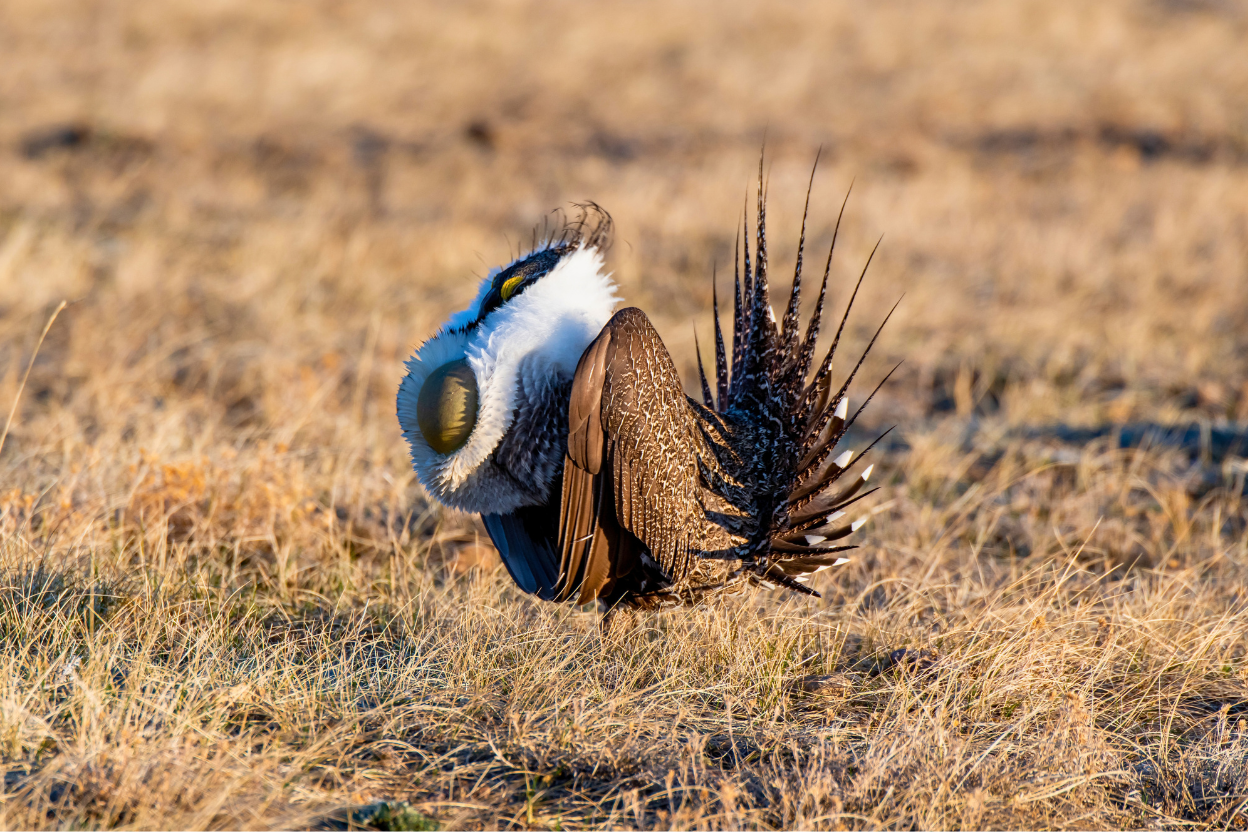
Greater Sage-Grouse (Centrocercus urophasianus) run the display most Americans have seen photographed. Males gather before dawn on sagebrush flats, fan their tails into spiked starbursts, and inflate a pair of bare yellow air sacs set into a fluffy white chest ruff. They lunge forward to push air in and out of the sacs, producing a gurgling, popping sound that is surprisingly quiet for a bird putting this much into it. Leks can hold dozens of males, all strutting through the same routine within metres of rivals doing the same thing.
Sharp-tailed Grouse (Tympanuchus phasianellus) are the version most reachable for a northern reader, using bog edges and shrubby openings in the boreal forest as well as the prairie habitat usually described. Their display is percussive rather than inflated. Males crouch, point their tails at the sky, and stamp their feet fast enough to blur, producing a dry purring sound, while the tail feathers click and the neck sacs deliver a low coo. In a group it becomes a single texture of sound before you can pick out any individual bird.
Long-tailed Manakin (Chiroxiphia linearis) breaks the rule that lekking males compete. Two males, an alpha and a beta, hold a display perch together and perform a coordinated routine, singing a precisely matched duet and taking turns leapfrogging over one another along the branch in a rolling, mechanical rhythm. When a female approves, only the alpha mates. The beta gets nothing that season, and researchers have found that his coordination with the alpha's song improves measurably as he ages, which is why the arrangement is usually described as an apprenticeship. The beta is not being exploited so much as waiting, since alpha positions are inherited by the birds who have spent years learning the duet.
Greater Bird-of-Paradise (Paradisaea apoda) takes the aesthetic to its limit. Males assemble in the crowns of tall emergent trees in New Guinea and display in the canopy, flank plumes thrown forward and shivering until the bird's outline dissolves into a spray of gold. What is easy to forget is that this is practised. Adult males have been recorded running through the full display in front of sub-adult males with no female anywhere near, and the younger birds attempting it, less completely.
Why the ornaments get out of hand
Two conditions combine to drive lekking ornament to extremes, and neither alone would do it.
The first is that female choice is the only thing that matters. In a resource-defending species, a female's decision is a compromise between the male and the territory. At a lek, the male is the entire proposition. Every element of his appearance and performance is therefore under direct selection from female preference, generation after generation.
The second is that nothing pulls in the opposite direction. A male who will never incubate an egg or feed a chick has no reason to stay inconspicuous, no need to remain efficient at gathering food for others, and no parental workload competing for his energy budget. He can afford plumes that make flight harder and colours that make him obvious to predators, because the only currency that counts is being chosen. The general question of why some males contribute nothing to raising young, and what determines it across the rest of the birds, belongs to why some male birds are deadbeat dads.
Put those together and you get a ratchet. Preference favours a trait, the trait exaggerates, preference tracks the exaggeration, and the process keeps running until the cost of the ornament finally catches up with the benefit of being chosen. Birds-of-paradise are what that ratchet looks like after a very long time.
The arithmetic of winning
The part that surprises people is how lopsided the outcome is. At a typical lek, mating is not shared out. A small minority of males account for the overwhelming majority of copulations, and a large number of displaying males father nothing at all, in that season and often across their whole lives. Males may attend a lek for years without ever mating.
What determines the winners is less obvious than it looks. The intuitive answer is that the toughest male wins, and recent work on Greater Sage-Grouse points the other way, finding that success in fights between males does not predict success with females. Aggression and attractiveness are not the same currency. Females appear to be reading the quality and persistence of the display itself, and a male who spends his morning fighting is a male not performing.
This extreme skew is also why lekking populations can be more fragile than their numbers suggest. A lek of a hundred males may represent a far smaller number of actual fathers, which matters for the genetic health of species already under pressure.
One more thing follows from a system where almost all males lose. Where female choice is this decisive, selection also favours males who find ways around it, which is the subject of sexual coercion in birds.
Going to see one
Leks are watchable, and they are among the best mornings available to a birder willing to be somewhere cold an hour before sunrise. They are also sensitive in a specific way, since a traditional site disrupted badly enough can be abandoned, and birds pushed off the ground lose that morning entirely. There are established rules for viewing them, and they are worth following exactly.
We cover the timing, the etiquette, and the optics in our field guide to how to watch bird courtship displays. If you want a display you can reach without a long drive, the American Woodcock sky dance runs at dusk across eastern North America and asks far less of you than a dawn lek does.
FAQ
A lek is a traditional display ground where male birds gather and defend small territories that contain no resources. No food, no nest site, nothing a female needs except the male himself. Females visit, watch the males perform, choose one, mate, and leave to nest elsewhere on their own. The absence of resources is what defines it. In ordinary territorial breeding, a female choosing a male is also choosing the land he holds, and at a lek she is choosing only him.
Lekking has evolved independently in many unrelated groups. In North America the grouse are the famous examples, including Greater Sage-Grouse, Sharp-tailed Grouse and the prairie-chickens. In the tropics the manakins and the cotingas display in forest, and the birds-of-paradise of New Guinea and Australia are the most elaborate of all. Some shorebirds lek, notably the Ruff, along with certain hummingbirds and bustards. The American Woodcock is a near relative of the pattern, with males displaying at dusk in loose aggregations rather than a tight shared arena.
Because in these species the female is choosing, and the display is the only information she has to choose on. A lekking male offers no territory and no parental help, so his performance is the entire basis of the decision. Displays are physically demanding and sustained over weeks, which is what makes them informative: a male who can dance hard at dawn every morning for a month is advertising condition that a weaker bird could not fake. Over evolutionary time, female preference for better displays is what drives the elaborate plumage and choreography.
No. In lek systems the female does everything alone, building the nest, incubating the eggs, and raising the young without any male contribution. This is not neglect so much as the structure of the system, since a male who mates with many females could not meaningfully help all of them, and the females of these species generally have precocial chicks that can walk and feed themselves soon after hatching. The freedom from parental work is exactly what allows lekking males to invest so heavily in display.
Far from it, and the imbalance is extreme. A small number of males account for most of the matings on a lek, while many males display for entire seasons, sometimes for their whole lives, without ever mating. What decides the outcome is not simply fighting ability. Research on Greater Sage-Grouse has found that winning fights against other males does not predict success with females, suggesting females are assessing the display itself rather than the dominance contests happening around it.