
Divorce in Birds: Why Even Albatrosses Leave Their Partners
The birds we hold up as models of lifelong partnership do leave each other, and the conditions that make them do it turn out to explain a great deal about how pair bonds work.
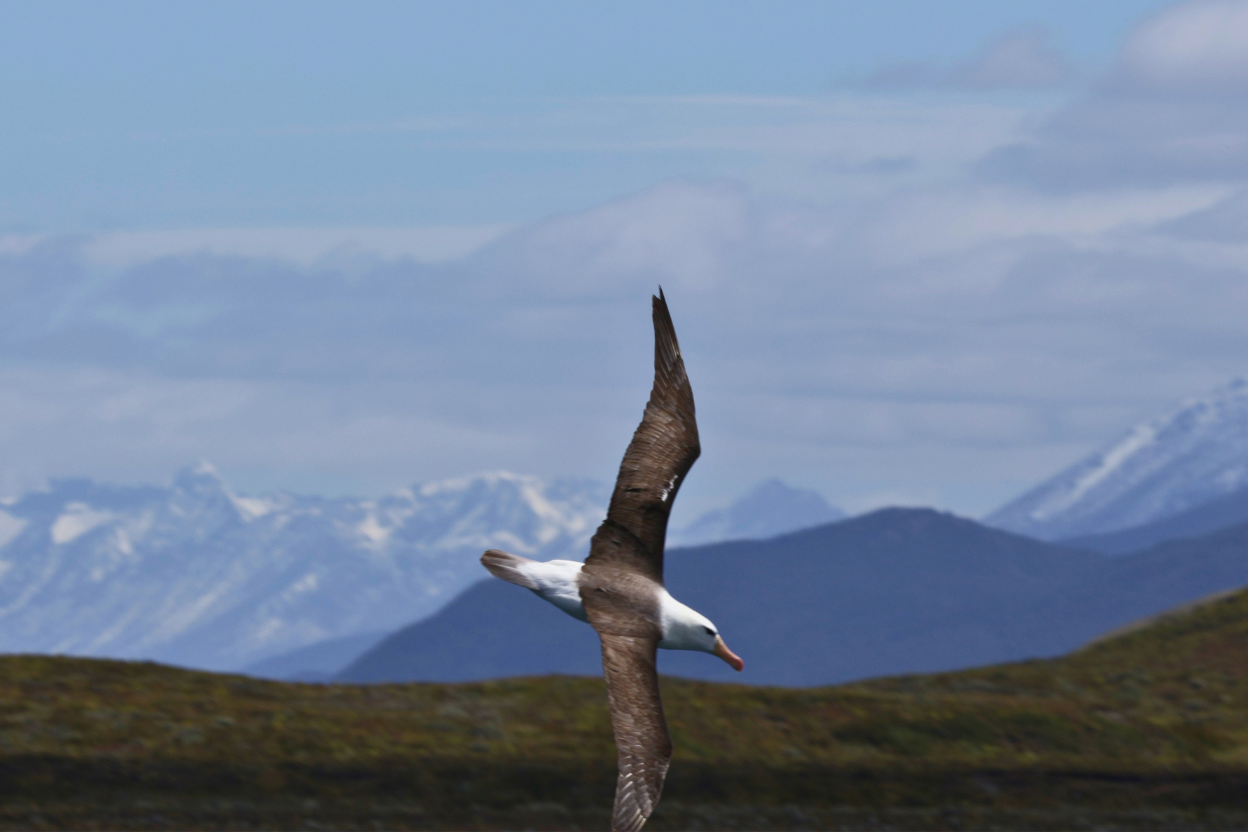
There were dozens of them in the Beagle Channel, Black-browed Albatrosses (Thalassarche melanophris) working the wind off the water with the Andes standing behind them. It is the kind of scenery that makes you stop talking. What holds the attention is not the setting though, it is the bird itself, a creature so completely adapted to a life on open water that the effort seems to have gone out of flying altogether. They tilt, they fall along a wave, they climb, and almost nothing about it looks like work.
These are also the birds we reach for whenever we want to say that some animals mate for life. Albatross pair bonds can run for decades, built on courtship rituals that take years to establish before a pair ever breeds. So the interesting question is not whether they are faithful, because they mostly are. The interesting question is what it takes to make one of them leave.
What ornithologists mean by divorce
The word has a precise technical meaning here, and it is narrower than the everyday sense. Divorce is when a bird re-pairs with a new partner while its previous partner is still alive. That last condition is what makes it interesting. A bird whose mate died over winter and returns to breed with someone new has not divorced, it has been widowed, and lumping those two together is the commonest error in popular writing about this subject.
The distinction matters because the two have completely different causes. Widowing tells you about mortality. Divorce tells you about decisions. In species with high adult mortality, most re-pairing is simply replacement, and you have to control for that before any claim about divorce means anything at all. The general question of how pair bonds form in the first place, and why social monogamy dominates in birds, belongs to our guide to how birds mate.
The albatross benchmark
Albatrosses, along with petrels, geese and swans, sit at the low end of the divorce spectrum. Rates in these groups are low, typically no more than a few per cent in a given year, and there are good reasons for that.
The investment in a partner is enormous. A Wandering Albatross (Diomedea exulans) may spend several years in courtship before breeding at all, learning a partner's specific displays and calls, and a breeding attempt in the larger albatrosses can occupy the better part of a year from egg to fledging. A pair that has already solved the problem of coordinating with each other holds a real advantage, since the alternative is starting the whole process again with a stranger. When the cost of finding and learning a new partner is that high, and the bird may live for fifty years, staying is almost always the better bet.
Almost always. Not always.
What made the Falklands albatrosses leave
The most detailed answer comes from New Island in the Falklands, a colony of roughly 15,500 pairs, where researchers followed Black-browed Albatrosses from 2004 to 2019 and assembled a dataset of 2,899 breeding attempts across 424 females. It is the kind of long-run record that lets you ask why a specific pair split rather than just how often it happens.
Divorce here was uncommon but not rare. The rate averaged 3.7% a year and varied a great deal between years, from a low of 0.8% to a high of 7.7%, and those yearly rates correlated significantly with warm sea surface temperature anomalies.
The first finding about individual birds was the expected one, with a twist in the detail. Failure triggered divorce, but when the failure happened mattered enormously. Females whose eggs never hatched were roughly 5.4 times more likely to divorce than females that bred successfully, and about 5.2 times more likely than females whose attempt failed later, after hatching. An early failure is the kind that might indicate an infertile or incompatible mate, and the birds appear to treat it that way.
The second finding is the one worth the article. Regardless of how the previous season had gone, the probability of divorce rose in warm years. The authors' state-space models showed that warm conditions increased the chance of a female switching mates even when the relationship had been successful. That should not happen under the simple version of the theory, where divorce follows failure.
The proposed mechanism runs through the food. Warmer surface water suppresses the productivity the whole food chain rests on, which means the birds travel further and work harder to find enough. That disrupts the timing a pair depends on, since an albatross pair must coordinate arrival, incubation shifts and foraging trips across enormous distances. A bird that arrives to find its partner not yet back has a decision to make, and in a hard year it may make a different one. The authors point to higher reproductive costs, shifted phenology and physiological stress as the likely routes.
The full range, from never to routine
Albatrosses are one end of a spectrum that turns out to be remarkably wide. Across birds, documented divorce rates run the whole distance from zero to effectively total, and the variation is not random.
Low divorce: albatrosses, petrels, geese and swans. Long-lived, slow-breeding, heavily invested in coordination with a specific partner.
High divorce: egrets and herons, plovers, swallows and martins, orioles and blackbirds. Shorter-lived, faster-breeding, and in many cases migratory or colonial, where partners are easy to replace and the cost of waiting for a specific bird is high.
This is why any headline claiming a single divorce rate for birds should be treated with suspicion. The number depends entirely on which species you picked, and the honest version of the statistic is always species-specific.
What actually predicts divorce
A comparative analysis published in 2023 tested the variation across many species and found two factors that hold up.
Migration distance. Migratory species divorce more than resident ones. The logic is timing. A resident pair simply stays together, but migrants have to reassemble each spring after months apart and often thousands of kilometres of independent travel. If one bird is late, the other faces a choice between waiting through part of a short breeding window or pairing with whoever is already present. Breeding seasons at high latitudes do not forgive delay, so the bird that waits may lose the year.
Male promiscuity. Species where males mate outside the pair bond more often show higher divorce rates. Divorce and extra-pair mating appear to be two versions of the same underlying strategy, which is spreading reproduction across more than one partner.
Several other traits travel with high divorce rates without necessarily causing them, including high adult mortality, colonial breeding, showy and sexually dimorphic plumage, and pair bonds that only operate during the breeding season rather than continuously.
Underneath all of this sits a genuine open question. One camp treats divorce as an adaptive strategy that improves a bird's reproductive output, and the other treats it as a largely incidental consequence of ecology, of mortality and mistiming and crowded colonies. The truthful answer is that both are probably operating, in different proportions in different species, and anyone offering a single clean explanation is overselling.
A strategy, not a failure
It helps to stop reading divorce through the human frame the word imports. No bird is disappointed. What is happening is a decision under uncertainty, made with limited information and a short season.
A bird that has just failed to raise young faces a real question about whether the problem was the partner, the territory, the weather, or luck. Staying means betting that last year was bad luck. Leaving means betting that the partner was the problem and that something better is available nearby. Neither is obviously right, which is exactly why both strategies persist and why the rate varies so much with how expensive each option is for a given species.
Seen that way, the albatross is not the exception to the rule. It is the case where staying is almost always the winning bet, which is why it takes something as large as a warming ocean to shift the calculation.
Watching pairs come and go
Re-pairing is visible if you know what you are looking at. Early in the season, courtship between birds that are already established looks different from courtship between birds that are not, and a bird performing full display to a partner it has bred with for years is doing something more perfunctory than a bird working to establish a new bond. Our guide to how to watch bird courtship displays covers reading these cues, along with the etiquette for doing it without interfering.
Two related questions sit next door. Not every bonded pair consists of a male and a female, which we cover in same-sex pairing in birds, and the question of who actually does the work once a pair forms is the subject of why some male birds are deadbeat dads.