
Why Some Male Birds Are Deadbeat Dads: The Real Numbers on Parental Care
Birds have a reputation as the good parents of the animal world. The data says the truth is far more uneven, and the exceptions run in both directions.
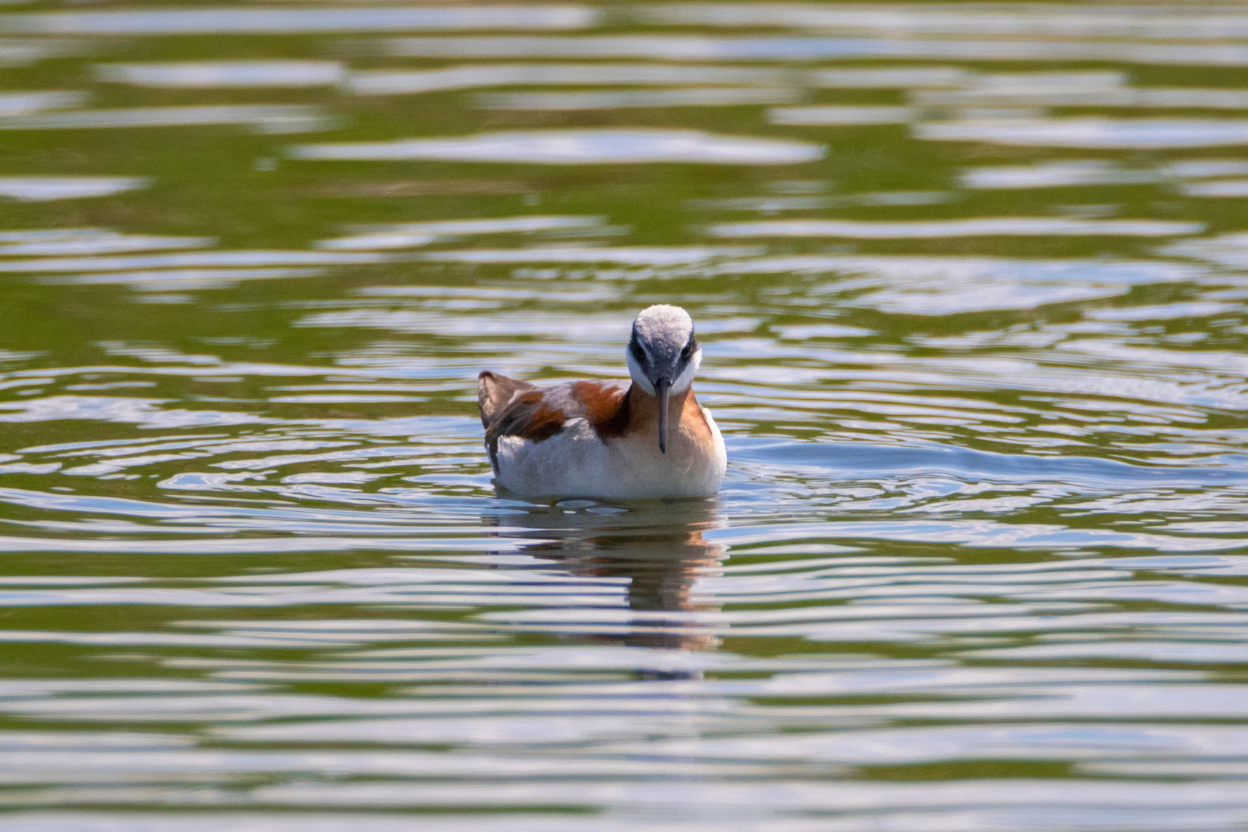
Phalaropes are one of the great pleasures of unglamorous birding. We have watched them along the tideline picking through the wrack, and better still out on the open water of a wastewater treatment lagoon, doing the thing phalaropes do: spinning in tight circles on the surface, stirring up a small vortex that lifts food within reach. It is an odd, mechanical, endlessly watchable behaviour, and it happens in places nobody would call scenic.
Here is the part worth knowing while you watch. If it is breeding season and one of those birds is brighter and larger than the others, you are almost certainly looking at a female, and she is very likely to leave. The male she paired with will incubate the eggs and raise the chicks by himself, and she may go and do the same thing again with somebody else.
Birds have a reputation as the good parents of the animal world. It is partly earned, and it hides an enormous amount of variation.
The number that needs updating
The figure repeated almost everywhere is that both parents share the work in over 90% of bird species. The estimate researchers actually use is lower. Andrew Cockburn's 2006 review in Proceedings of the Royal Society B surveyed the modes of parental care across the birds and put biparental care at about 81% of species, still a clear majority and a rather less tidy one than the old number suggests.
More useful than either figure is the discovery that "parental care" is not a single thing that a bird either does or does not do. Once you separate the jobs, the neat picture of the sharing couple comes apart.
Care is not one job
A comparative analysis of 1,533 species, published in Nature Communications in 2023, broke the breeding cycle into stages. The division of labour looks completely different depending on which stage you examine.
Nest building: both sexes build in about 61% of species, the female builds alone in about 35%, and the male builds alone in under 4%.
Incubation: the female incubates alone in about 50% of species, both share it in about 48%, and the male incubates alone in under 2%.
Feeding the young: both parents provision in about 88% of species, the female provisions alone in about 11%, and the male alone in under 2%.
Read those together and the popular image resolves into something far more specific. Shared care in birds is overwhelmingly shared chick feeding, and it sits on top of a division of the earlier work that leans heavily female. In half of all bird species the female does the entire incubation herself. The male who turns up to help once there are mouths to fill is doing real work, and he is not doing half of the job.
This also explains why the deadbeat framing needs care. Very few males do literally nothing. What varies is how much, and at which stage, and the range runs from a male who never approaches the nest to one who does every single thing except lay the egg.
The fathers who do everything
Male-only care is rare, which is exactly what makes the cases famous.
The Emperor Penguin is the extreme. The female lays a single egg, transfers it to the male, and returns to the sea. He balances it on his feet under a fold of belly skin and incubates it through the Antarctic winter for roughly 64 days, huddling with other males against the weather, eating nothing. By the time the chick hatches he has fasted for something close to four months and lost a large fraction of his body weight. The female returns, finds him among thousands of identical emaciated birds, and takes over.
Less dramatically, males of many species do substantially more than the average. The point of naming them is not sentimentality. It is that any explanation of why some males contribute nothing has to also explain why some contribute everything, and a theory that only accounts for the deadbeats is not a theory.
The females who leave
The mirror image is sex-role reversal, and North America has two excellent examples.
Wilson's Phalarope (Phalaropus tricolor) reverses the usual plumage rule, with the female larger and more brightly marked than the male. She lays a clutch, hands it over, and departs, potentially pairing with several males in a season while each incubates and raises his brood alone.
Spotted Sandpiper (Actitis macularius) goes further and is the better story. The female arrives on the breeding grounds first, establishes and defends the territory, and may mate with up to four males, each of whom is left with a clutch. One female in Minnesota laid five clutches for three males inside about six weeks. The males are smaller and less aggressive, they set up small sub-territories inside hers, and this was the first bird species in which males were found to carry higher levels of prolactin, the hormone associated with parental care, than females.
One honest qualification, because it is usually left out. Spotted Sandpipers are not uniformly polyandrous. In other places and other years they breed monogamously with the female helping to raise the young. The reversal is a strategy the species can run, not a fixed identity, and that flexibility is itself a clue to what is going on.
What actually explains the pattern
The organizing idea is parental investment, and the logic is straightforward even though the details are still argued over.
Whichever sex invests more in each reproductive attempt becomes the limiting resource, and the other sex competes for access to it. The sex that can walk away at lower cost is the sex free to pursue additional mates. In most birds that is the male, which is why most of the deserters are male and why male ornament and display are usually the showier.
Two ecological conditions then decide how far it can go. The first is whether one parent can manage. Most birds hatch helpless and need feeding for weeks, which makes desertion expensive because the chicks may simply die, and this is why biparental care dominates. Where chicks hatch mobile and able to feed themselves, as in the sandpipers and phalaropes, one adult is genuinely sufficient, and the other is freed. The second is what the freed bird can do with the time. Where a deserting parent can start another clutch or attract another mate, desertion pays. Where it cannot, staying is the better option regardless.
The extreme version of male desertion is the lek, where males invest nothing beyond the display itself, and we cover that system in lekking birds and their dance battles. The extreme version of desertion by both parents is brood parasitism, where a bird abandons the egg to a different species entirely, which is the subject of brood parasitism and the cuckoo problem.
Does a male know whose chicks they are?
A popular explanation holds that males invest less when they are less certain the young are theirs. It is intuitive, it is frequently stated as fact, and the evidence for it is genuinely mixed.
What the comparative work supports is narrower than the general claim. Across species, higher rates of extra-pair paternity are associated with males providing a smaller share of the food for nestlings. But the same relationship does not appear for nest building, courtship feeding, or incubation, where males of high extra-pair species do not reduce their effort. Individual studies also split, with some finding males adjusting care and others finding no such effect at all.
So the fair summary is that certainty of paternity looks like one real influence on one specific part of parental care, rather than the master explanation it is often presented as. The broader distinction between who a bird pairs with and who fathers the chicks runs through this whole subject, and we set it out in our guide to how birds mate.
Reading it at the nest
This is all watchable, with patience and distance. At an active nest, the question of which adult is doing what is answerable over an hour of observation, and in species where the sexes look alike, behaviour is often the only way to tell them apart at all. Watch who incubates, who brings food, how often, and whether one bird is doing markedly more of the carrying.
Do it from far enough away that you change nothing, since attention at a nest draws predators and repeated disturbance costs broods. Our field guide to how to watch bird courtship displays covers working at that kind of distance, and for what happens when a partnership does not survive the season, see divorce in birds.