
Brood Parasitism and the Cuckoo Problem: An Arms Race Fought Egg by Egg
A Song Sparrow feeding a fledgling twice its size is not a bird being stupid. It is the visible end of an evolutionary contest that has been running for millions of years.
The Song Sparrow was working itself to exhaustion. In front of it, mouth open and demanding, sat a fledgling Brown-headed Cowbird considerably larger than the bird feeding it, and the sparrow was going back and forth without pause, delivering food into a gape that belonged to another species entirely. It is one of those sights that stops you, partly because it is faintly absurd and partly because the sparrow is so obviously committed.
The temptation is to read it as a bird being fooled, and that is not quite right. What you are watching is the last visible stage of a contest that has been running between these two lineages for a very long time, in which the sparrow's ancestors have already lost several rounds. The interesting question is not why the sparrow is feeding the wrong chick. It is why, at every earlier point where it could have stopped this, it did not.
Parenthood, outsourced completely
Obligate brood parasites do not build nests, do not incubate, and do not feed young. They lay their eggs in the nests of other species and leave, and they have no alternative strategy, since obligate means exactly that. Roughly a hundred bird species live this way, around 1% of all birds, and they include a number of Old World cuckoos, the New World cowbirds, the honeyguides, the indigobirds and whydahs, and a single duck.
The appeal is obvious once you count what it saves. Nest building, incubation and weeks of feeding are the expensive parts of reproduction, and a parasite skips all of them. Freed from that, a female can lay far more eggs in a season than a bird tied to one nest ever could. Where the deserting parents in most species still pay some cost, described in our guide to why some male birds are deadbeat dads, the brood parasite has pushed the logic to its endpoint and pays none at all.
The cost lands on the host, and it is severe. A parasitized nest usually fledges fewer of the host's own young, and frequently none.
The cuckoo and the reed warbler
The best-understood case in the world is the Common Cuckoo (Cuculus canorus) and the Common Reed Warbler (Acrocephalus scirpaceus), studied intensively since Nick Davies and Michael Brooke's work in the late 1980s, which reshaped the field.
The female cuckoo watches a reed warbler nest, waits until the owners are away, and lays with astonishing speed, often removing one host egg as she goes so the count still looks right. Her egg hatches early. The cuckoo chick, blind and naked, then works the host's remaining eggs onto its back one at a time and levers them over the rim of the nest. Within a day or two it is alone, and the warblers feed it until it is several times their size.
The detail that elevates this from anecdote to biology is that Common Cuckoos are divided into gentes, host-specific races that each specialize on one host species and lay eggs matching that host's eggs in colour and pattern. So this is not one arms race. It is many, running in parallel inside a single cuckoo species, each against a different host, and recent work has linked exactly this process to the formation of new cuckoo species.
The arms race, and how we know it is still running
What makes the cuckoo system so valuable scientifically is that the contest is measurable, and the measurements show it is still moving.
Host rejection is strongly conditional rather than all-or-nothing. A reed warbler presented with a well-matched egg frequently accepts it, while an obviously wrong egg is often ejected, and measured rejection rates vary considerably between populations and with how convincing the forgery is. In Great Reed Warblers, a related and heavily parasitized host, the great majority of clearly non-mimetic eggs are rejected. That discrimination is the host side of the ledger, and it is precisely the pressure that selects for better cuckoo mimicry.
The clearest evidence that this is an ongoing process rather than a finished one is geographic. Cuckoo eggs collected in Hungary mimic their hosts' eggs more closely than cuckoo eggs collected in Japan. Same parasite species, different populations, different stages of the same race. Where hosts have been discriminating for longer, the forgeries are better, because the sloppy ones were rejected out of existence.
The cowbird, and the bird in your neighbourhood
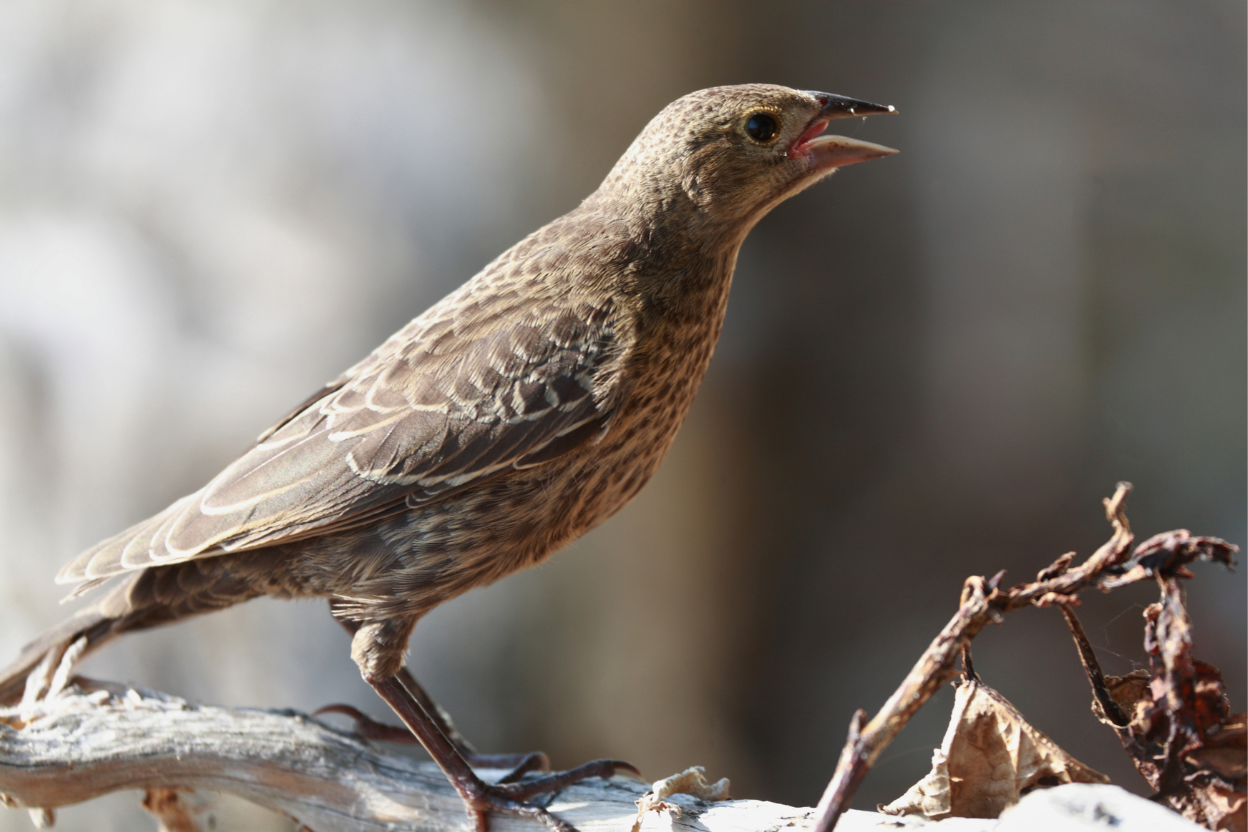
North America's version is the Brown-headed Cowbird (Molothrus ater), and it took a different route. Rather than specializing, it generalizes aggressively. Cowbirds have been recorded parasitizing 226 host species and regularly use about 132 of them, from warblers weighing 8 to 15 grams up to blackbirds over 100 grams. Song Sparrow, Yellow Warbler, Red-eyed Vireo, Wood Thrush and Common Yellowthroat are among the most frequently used, which is why the sight of a small bird feeding an enormous cowbird fledgling is so familiar.
Cowbird chicks do not evict their nest mates the way a cuckoo chick does. They simply outcompete them, hatching earlier and larger and monopolizing the food until the host's own young starve or fledge underweight.
The Yellow Warbler's answer is the best story in North American ornithology on this subject. A Yellow Warbler cannot eject a cowbird egg, because its bill is too small to lift or puncture one. So it does something else entirely: it builds a new nest floor directly over the parasitized clutch, burying the cowbird egg along with its own, and starts again on top. One recorded female, facing a cowbird that returned five separate times, built six layers of nest floor. Yellow Warblers also have a specific alarm call, a repeated seet, used for cowbirds in particular, given most often during egg laying when they are most vulnerable, and Red-winged Blackbirds nesting nearby have been shown to listen to it and benefit.
So why does the Song Sparrow accept?
Given all that, the obvious question is why so many hosts do nothing. Several answers are working at once.
Rejection has costs. A host that learns to eject odd-looking eggs will sometimes eject its own, and in a poorly lit nest that error is easy to make. A bird with a small bill may damage its own clutch trying to remove a thick-shelled parasite egg, and some hosts abandon a perfectly viable nest by mistake. If parasitism is rare in a population, the cost of those errors can exceed the cost of occasionally raising a cowbird.
The host may be new to the problem. Rejection behaviour has to evolve, and it only evolves under sustained pressure. Cowbirds expanded their range enormously as forests were fragmented into the open and edge habitat they favour, which means many hosts are facing a parasite their ancestors rarely met. They have not had time.
And there may be retaliation. The mafia hypothesis proposes that parasites punish rejection by destroying the nest, making acceptance the safer choice. One experiment found that 56% of nests where the parasite egg was ejected were subsequently destroyed, against 6% of nests that accepted, which is striking. It should be treated carefully all the same, since the behaviour has been experimentally demonstrated in only one host species, and a separate study drawing on 22 years of data found no support for it in another. It is a live hypothesis with real evidence and real contradictions, not a settled fact.
A genuine conservation problem
Worth saying plainly, because it complicates the story. Brown-headed Cowbirds are native birds doing what they evolved to do, and they are not villains. But human land use has vastly expanded the habitat that suits them, pushing them into contact with host populations that never had to cope with them, and for a few endangered songbirds the added pressure is serious enough that wildlife agencies run cowbird control programmes to protect them.
That is an uncomfortable trade, removing one native species to preserve another, and it is worth understanding that the underlying cause is habitat change rather than the cowbird's behaviour.
Watching it happen
All of this is visible without any special access. The oversized fledgling being fed by a smaller bird is the most obvious sign and is common in summer, and it is worth identifying the host rather than just enjoying the absurdity, because the pairing is data. Earlier in the season, watch for hosts mobbing a female cowbird near a nest, since hosts frequently recognize the parasite as a threat even when they will accept its egg later. In areas with Yellow Warblers, the seet call is learnable.
Do all of it at a distance that changes nothing, since human attention near a nest attracts predators. Our field guide to how to watch bird courtship displays covers working that way, and for the wider picture of the breeding systems this behaviour sits inside, see how birds mate. Conflict between the sexes rather than between species takes a different and equally uncomfortable form, which we cover in sexual coercion in birds.