
Far Eastern Curlew in Quebec: A First for Eastern North America
A birder went to Carleton-sur-Mer to see a Hudsonian Whimbrel and found the wrong curlew standing beside it. What the record is, and how to behave if you go.
On Tuesday 1 September 2026, Florent Bélanger went down to the marina at Carleton-sur-Mer, on the Baie des Chaleurs in Gaspésie, to look at a Hudsonian Whimbrel. That is an unremarkable reason to be out on a tidal flat in early September. Standing near the whimbrel was a second curlew, noticeably bigger, with a bill that was far too long for the bird he had come to see. He photographed it without knowing what it was. It was only after the photos went up on eBird, and a reviewer wrote to him asking about the habitat, that he got the answer. He had found a Far Eastern Curlew (Numenius madagascariensis), a bird of the East Asian flyway, standing on a Quebec mudflat.
We should say plainly that we did not see this bird. We are writing it down because a first for eastern North America deserves a clear record, and because the way news of a bird like this travels, and how people behave once it does, matters more here than usual.
What the record is
According to QuébecOiseaux, this is the first Far Eastern Curlew ever recorded in Quebec, the first anywhere in eastern North America, and the third for Canada. The identification was confirmed through eBird review, and like any provincial first it still has to go through the formal records review that governs the Quebec list before it is official. The two Canadian records that came before it were both on the western side of the country, one at Vancouver in 1984 and one at Whitehorse in 2017. That geography is the point. This is a species whose entire world runs down the far side of the Pacific, from breeding grounds in northeastern Asia to wintering flats in Australia, and the handful of North American records sit where you would expect them to sit, on the Pacific side. A bird on the Gaspé coast is not a small extension of that pattern. It is a different continent's worth of wrong.
The news moved fast. QuébecOiseaux reported that several dozen birders made the drive to Carleton-sur-Mer within days, some from as far as Pennsylvania, which for a bird in Gaspésie is a serious commitment of highway.
A brief word on the bird itself
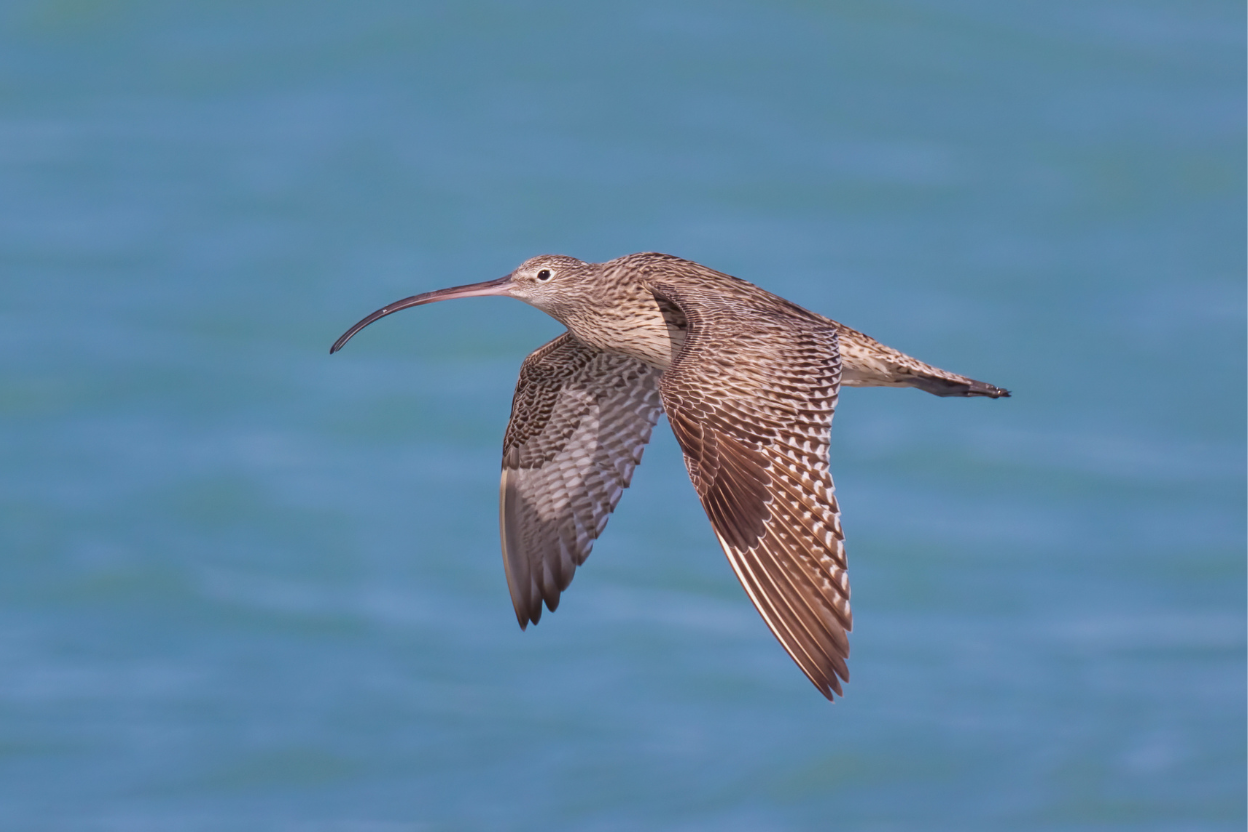
The Far Eastern Curlew is, by most accounts, the largest sandpiper in the world, running 60 to 66 cm long with a wingspan around 110 cm and a scimitar of a bill that on females averages well over 18 cm. In a North American context there are two birds to think about. The first is the one Florent was already looking at. A Hudsonian Whimbrel is much smaller, shorter billed, and wears bold dark stripes on the crown, which the curlew does not, so the two side by side make an easy comparison once you have both in the frame. The second is Long-billed Curlew (Numenius americanus), the North American bird closest in size and bill length, which carries a warm cinnamon wash through the underparts and wing linings that the Far Eastern lacks. eBird also separates Far Eastern from Eurasian Curlew on a light brown rather than white rump and heavily marked rather than clean white underwings, which is the comparison that matters in Asia and could matter here if a second Old World curlew ever turns up.
Why an endangered bird makes this complicated
This is not just a rare bird, it is a declining one. The IUCN lists the Far Eastern Curlew as Endangered and puts the world population at roughly 20,000 to 35,000 mature individuals, a number that has been falling. The main driver sits thousands of kilometers from Gaspésie, in the tidal flats of the Yellow Sea, where the staging habitat the whole flyway depends on has been steadily reclaimed and degraded. Around three quarters of the species spends the non-breeding season in Australia, and Australia lists it as Critically Endangered under its own legislation.
That context changes the arithmetic of a stakeout. One individual represents a meaningfully larger fraction of its species than a lost warbler does. Reports circulating in the Quebec birding community have described the bird as unsettled by the number of people out on the flats, and Florent Bélanger has publicly asked that people keep their distance. QuébecOiseaux publishes a code d'éthique that covers exactly this situation, and it is worth reading before the drive rather than after. Stay back further than feels necessary, work from the road or the edge of the flat rather than walking out, let the bird feed, and accept a worse photograph than the one you wanted. A bird this far off course is running on reserves it cannot easily replace.
Finding out whether it is still there
By the time you read this the curlew may have moved on, and there is no substitute for a same day confirmation before committing to a long drive. This is precisely the job that regional chat servers do better than anything else, because someone standing on the flat can post a refind and a photo within minutes, hours before any alert digest reaches you. The French language Québec Birds server is the one that carries this bird, and we keep a running directory of the rest in our roundup of birding Discord servers. Set up the reliable backbone alongside it, which we walk through in How to Find Rare Birds, and check the recent checklists for the Carleton-sur-Mer hotspots directly on eBird. QuébecOiseaux also runs a rare bird page for the province.
One bird, and what it is worth
It is tempting to read a record like this as a sign of something, and the honest answer is that one bird is one bird. A single vagrant tells you far less than people want it to, which is the distinction we work through in Bird Vagrancy and Range Expansion. What makes this one count is not what it proves but what it is: a documented first, found by someone who noticed that the bird next to his target was the wrong shape, and who put photographs on eBird where a reviewer could check them. That is the whole mechanism. The habits that turn a good look into a permanent record are in How to Document and Report Vagrant Birds, and the discipline of questioning an odd bird before you name it is in How to Identify a Vagrant or Range-Expanding Bird. Florent Bélanger did the ordinary thing well, and Quebec has a species on its list that nobody expected to add.
FAQ
It is the world's largest sandpiper, a shorebird of the East Asian flyway that breeds in northeastern Asia and winters mostly in Australia. It runs 60 to 66 cm long with a wingspan around 110 cm and an exceptionally long decurved bill. The IUCN lists it as Endangered, with a world population of roughly 20,000 to 35,000 mature individuals.
On the tidal flats by the marina at Carleton-sur-Mer, in Gaspésie, on the Baie des Chaleurs. It was found on 1 September 2026 by Florent Bélanger, who had gone there to look at a Hudsonian Whimbrel and noticed a second, much larger curlew standing nearby.
Not for the continent, but it is the first for Quebec and the first anywhere in eastern North America, and the third for Canada. The two earlier Canadian records were both in the west, at Vancouver in 1984 and at Whitehorse in 2017. The Quebec record still has to clear formal review before it is official.
Presence changes daily and we cannot answer that from here. Check the recent eBird checklists for the Carleton-sur-Mer hotspots, and the Québec Birds Discord server for a same day refind, before committing to a long drive.
Size and bill first. The Far Eastern Curlew is much larger, with a far longer decurved bill. The Hudsonian Whimbrel also shows bold dark stripes on the crown, which the curlew lacks. Seen together, as they were at Carleton-sur-Mer, the difference is obvious.
Extremely. This is the third Canadian record, and the first two were both in the west, at Vancouver and Whitehorse. The Quebec bird is the first ever found east of Yukon, and it still has to clear formal review.