
How to Stop Birds From Hitting Windows (What Actually Works)
Two simple rules decide whether any fix works. Here is how to stop birds from hitting windows, ranked from dot tape and paracord curtains to cheap DIY, with what to skip.
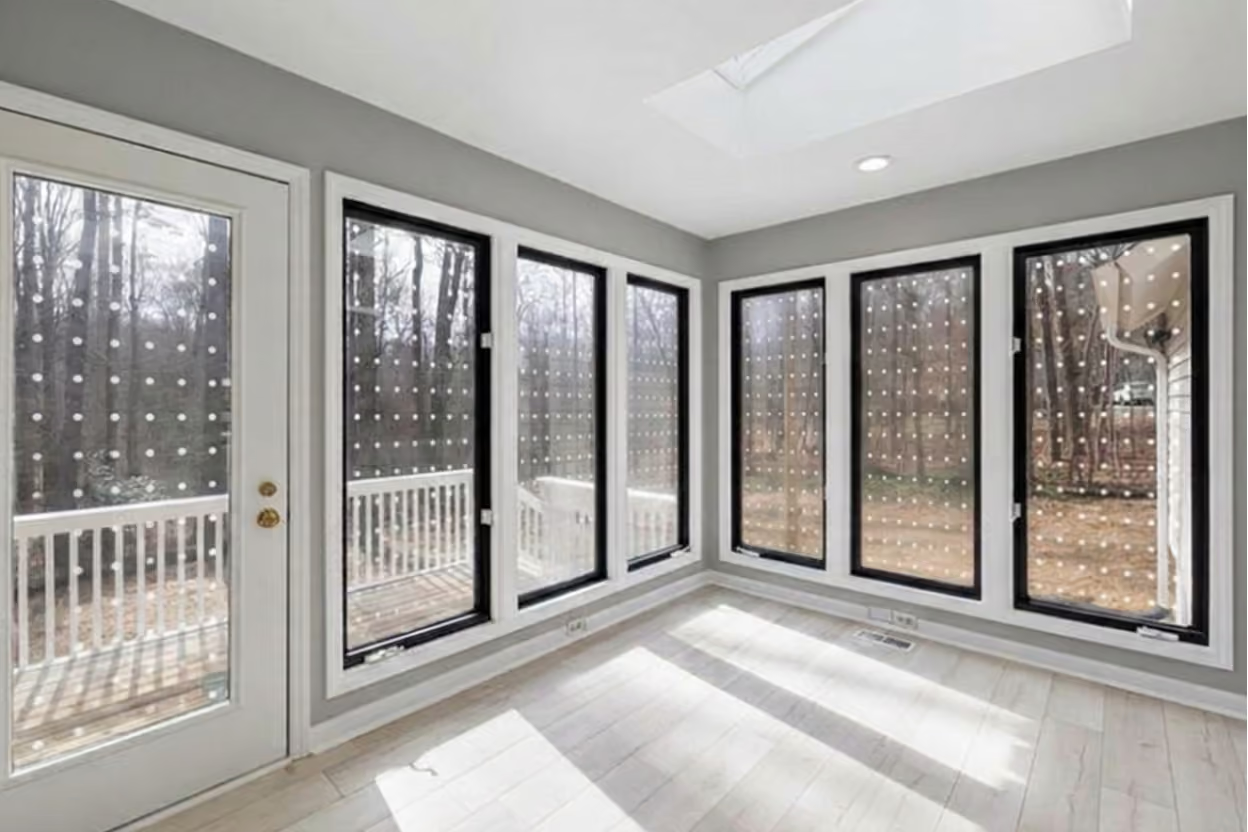
A few years ago we finally did to our own worst window what we had been telling everyone else to do. We applied a grid of small dots across the outside of the glass, the picture window that had been killing birds against the garden for years. The thudding stopped. Not reduced, stopped. That is the quiet promise of this guide, and it is backed by research as much as by our own relief. Done correctly, making a window visible to birds can cut strikes by up to 90 percent, and most of the methods are within any homeowner's reach.
If you have not yet read why this happens, the short version is that glass reflects the sky and greenery or offers a clear view through to the other side, so a bird sees habitat or open air and flies straight at it. We explain the full mechanism in why birds hit windows. This guide is about the fix, and we will tell you what works before we tell you what to buy.
The two rules that decide whether anything works
Almost every failed attempt to bird proof a window breaks one of two rules, and almost every success follows both.
The first rule is that the treatment has to be on the outside of the glass. This is the single most common mistake. A pattern applied to the inside is hidden by the daytime reflection on the outer surface, so the bird never sees it. Whatever you use, it goes on the exterior face of the window.
The second rule is close, even spacing. A bird will try to fly through any gap it thinks it can fit through, so the markings have to be dense enough that no gap looks passable. The guideline is the two inch rule, markings spaced no more than two inches apart across the whole window, which protects even the smallest birds like hummingbirds and kinglets. A couple of widely spaced stickers does nothing, because the bird simply aims for the clear space between them. The one exception is hanging cords, which are more visible and work at about four inches apart. Coverage and spacing matter far more than the particular product or pattern.
What works, ranked
With those two rules in mind, here are the approaches that actually prevent collisions, roughly from the most effective and practical down. (As an Amazon Associate we earn from qualifying purchases.)
Dot tape. The easiest way to get correct spacing without measuring every dot yourself is a purpose made tape of small dots. You apply the tape, peel away the carrier, and a tidy grid of dots stays behind on the glass, leaving most of the view clear. Feather Friendly tape is the best known of these and is genuinely effective when applied across the whole window at the correct spacing. For most homeowners this is the sweet spot of effectiveness, looks, and durability.
Paracord curtains, or BirdSavers. Also called zen curtains, these are simply lengths of paracord hung vertically on the outside of the window about four inches apart. They are highly effective, easy to live with, and they are the method the Cornell Lab of Ornithology uses on its own headquarters. You can buy a paracord BirdSavers set sized to your window, or make your own using the free instructions on the BirdSavers how to page. If a grid of dots is not to your taste, this is our favorite alternative.
External insect screens. A full insect screen mounted on the outside of the window does two good things at once. It hides the reflection, and on the rare occasion a bird does come in, the mesh cushions the blow instead of the hard glass. If your windows can take external insect screens, they are one of the most effective options of all, with the bonus of keeping bugs out.
Decals, spaced correctly. Decals and stickers get a bad name only because people use too few of them. Applied to the outside and spaced within the two inch rule across the entire pane, window decals do work, and the patterned ones can look attractive. Just remember that two or three on a big window is decoration, not protection.
UV film, with honest caveats. Some films carry a pattern in ultraviolet, visible to many birds but nearly invisible to us, which is appealing if you do not want to see the treatment. We rank it lower than the options above, and on purpose. Its effectiveness varies with the angle of the sun through the day, it works best on bright south facing glass, and some birds, including owls, see ultraviolet poorly, so it is not reliable for every species. Like everything else it must go on the outside. It is a reasonable choice where appearance matters most, but it is not the strongest performer, and a patterned film you can actually see will protect more birds.
The cheap, do it yourself options
You do not have to spend anything meaningful to save birds. The same two rules make a bar of soap or a jar of tempera paint into a perfectly good deterrent. Mark the outside of the glass in a grid roughly two inches by two inches, using soap for a temporary fix or tempera paint for something that lasts months and survives rain. You can keep it to a plain grid or, if you like, turn it into artwork. It looks a little unusual, but it works, because the birds stop hitting the glass.
What does not work
It is worth being blunt about the popular fixes that fail, so you do not waste money on them. A single hawk or falcon silhouette stuck to the glass does almost nothing, despite being sold for exactly this purpose, because birds do not read it as a predator and the rest of the window stays open. The same goes for one or two decals on a large pane, for anything applied to the inside of the glass, and for ultrasonic gadgets, which have no effect on window strikes at all. If a fix does not put a closely spaced, exterior pattern across the whole window, it is not really doing the job.
Where to start
If you only treat a few windows, start with the dangerous ones, the large panes that reflect your garden or sit near a feeder, and the species most at risk are the ones in the birds that hit windows most often. Then remember the other half of the collision story, the night. During spring and fall migration, turning off unnecessary lights helps the night fliers, as we explain in why birds fly into lights at night. Set against everything in the causes of bird deaths in North America, a treated window is one of the most concrete wins available to any of us. We did ours and the thudding stopped, and yours can too. Small changes add up, and together we make a difference.
FAQ
Make the glass visible from the outside. Birds hit windows because the glass reflects sky and trees or looks transparent, so the fix is to break up that reflection with a pattern applied to the exterior surface. Closely spaced dots, lines, tape, or hanging cords all work, and done correctly they can cut strikes by up to 90 percent. The key is full coverage at close spacing, not a single decal.
Only when they cover most of the window and are spaced very closely, no more than two inches apart, on the outside of the glass. A couple of stickers on a large pane do almost nothing, because a bird simply aims for the clear gap between them. Spaced correctly across the whole window, decals are effective, but the spacing matters far more than the design.
No. Markings applied to the inside of the glass are largely useless, because daytime reflections on the outer surface hide them from the bird. To work, decals, tape, paint, or film must go on the exterior surface, where they break up the reflection before the bird commits. Applying treatments to the inside is the most common mistake people make.
The most reliable options are closely spaced exterior patterns. Dot tape products and one-way films applied across the whole window, paracord curtains known as BirdSavers, and external insect screens that both hide reflections and cushion any impact all rank near the top. The Cornell Lab uses paracord BirdSavers on its own building. Whatever you choose, it must be on the outside and densely spaced.
No. A single hawk or falcon silhouette does little to prevent collisions, despite how often they are sold for the purpose. Birds do not read it as a predator to avoid, and the rest of the glass stays an open invitation. What protects a window is dense, closely spaced coverage across the whole pane, not the shape of any one sticker.